Close Menu
    What's Hot

    Saudi Arabia Warns Iran of Retaliation as Gulf War Escalates

    March 8, 2026

    Indian investors continue to power Dubai’s property boom 

    March 8, 2026

    Oil spike, war jitters rattle crypto markets as Bitcoin slips below $70,000

    March 8, 2026
    Facebook X (Twitter) Instagram
    • Politics
    • Economy
    Facebook X (Twitter) Instagram
    Gulf News Week
    Subscribe
    Monday, March 9
    • Home
    • Politics
      • Europe
      • Middle East
      • Russia
      • Social
      • Ukraine Conflict
      • US Politics
      • World
    • Region
      • Middle East News
    • World
    • Economy
      • Banking
      • Business
      • Markets
    • Real Estate
    • Science & Tech
      • AI & Tech
      • Climate
      • Computing
      • Science
      • Space Science
      • Tech
    • Sports

      T20 World Cup: ‘Unfinished Business’ – Unbeaten South Africa Collide with New Zealand in Semi-Final Blockbuster

      March 5, 2026

      Tragedy Strikes Indian Camp: Rinku Singh Leaves T20 World Cup Squad After Father’s Demise

      February 28, 2026

      Game Changer: TCL Redefines Home Sports Viewing with Next-Gen QD-Mini LED Displays

      February 27, 2026

      Humbert Ousts Defending Champion Tsitsipas in Dubai First-Round Blockbuster

      February 25, 2026

      South Africa Stun India in World Cup Blockbuster, Assert Dominance with Commanding 76-Run Victory

      February 23, 2026
    • Health
    • Travel
    • Contact
    Gulf News Week
    Home»Politics»Middle East»Born after the Arab Spring: 37 million Egyptians have no memory of 2011
    Middle East

    Born after the Arab Spring: 37 million Egyptians have no memory of 2011

    Gulf News WeekBy Gulf News WeekJanuary 26, 2026Updated:January 26, 2026No Comments4 Mins Read
    Share Facebook Twitter Pinterest Copy Link LinkedIn Tumblr Email VKontakte Telegram
    Born after the Arab Spring: 37 million Egyptians have no memory of 2011
    Share
    Facebook Twitter Pinterest Email Copy Link

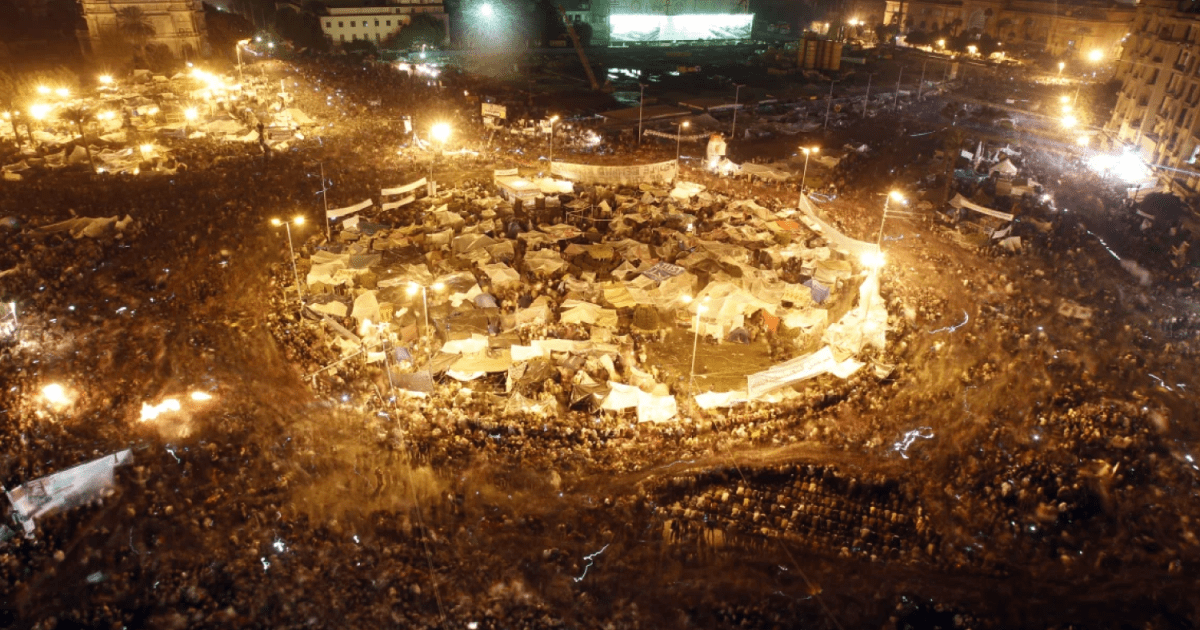
    One-third of Egyptians were born after the 2011 Arab Spring protests which removed longtime President Hosni Mubarak.

    Fifteen years have passed since the Arab Spring protests erupted in Egypt.

    Inspired by the successful uprising in Tunisia just 11 days earlier, when demonstrators succeeded in bringing down the country’s president, Zine El Abidine Ben Ali, the Egyptian people wanted freedom and their voices to be heard.

    For 18 days, millions took to the streets to protest, driven by high unemployment, poverty and political repression, and demanding the departure of longtime President Hosni Mubarak.

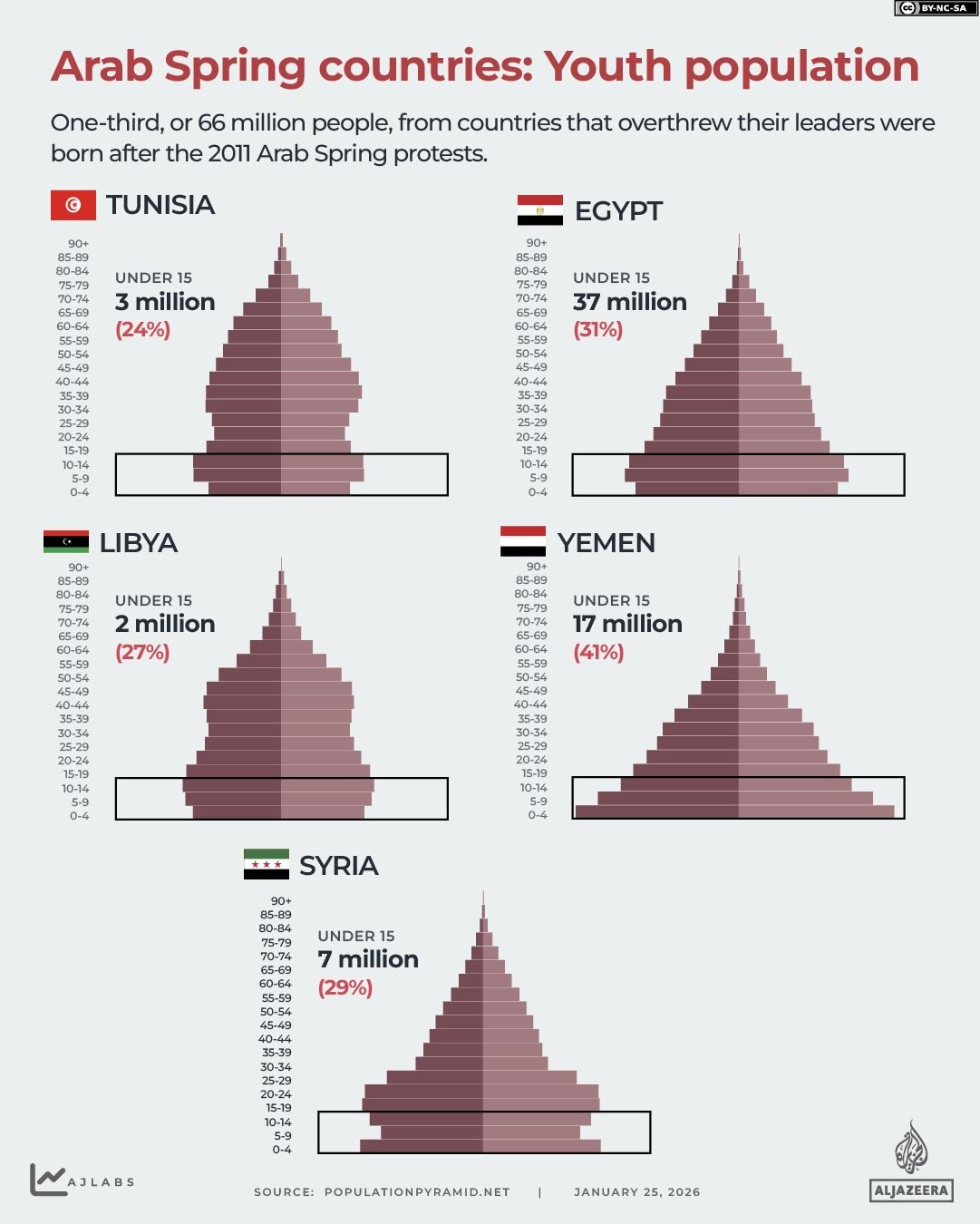
    With a median age of approximately 24 years, Egypt ranks among the younger countries globally, with roughly 37 million people, or 31 percent of the population, under the age of 15. For those children, the Arab Spring was a historical event shared through the memories of the older generation.

    (media)

    Egypt’s young population

    In 2011, Egypt’s population was 83 million with a 12 percent unemployment rate and a gross domestic product (GDP) per capita (in current USD) of $2,590, according to the World Bank. One US dollar bought 5.8 Egyptian pounds.

    Fifteen years later, Egypt has added roughly 37 million people, bringing its population to nearly 120 million. The country now has an unemployment rate of 6.4 percent and a GDP per capita of $3,339. One US dollar now buys about 47 Egyptian pounds, weakening purchasing power for many citizens.

    Egypt has a young population, with more than half of its citizens under the age of 24, about seven years younger than the global average of 31.

    According to the Economic Research Forum, Egypt needs to create 1.5 million jobs each year. However, over the past two decades, it has managed to create only 600,000 jobs annually.

    Advertisement

    There are currently some 3.6 million students enrolled in higher education, including universities and technical institutes. The government has set a target to increase this to 5.6 million by 2032 to meet the demands of a modernising economy.

    More than 80 percent of the people are active internet users, and this is driven almost entirely by the youth, with mobile connections and heavy social media use.

    While the national unemployment rate has dropped to a record low of 6.4 percent, youth unemployment (ages 15–29) stands at about 14.9 percent, according to Egypt’s Central Agency for Public Mobilization and Statistics (CAPMAS).

    What happened over 18 days in Egypt?

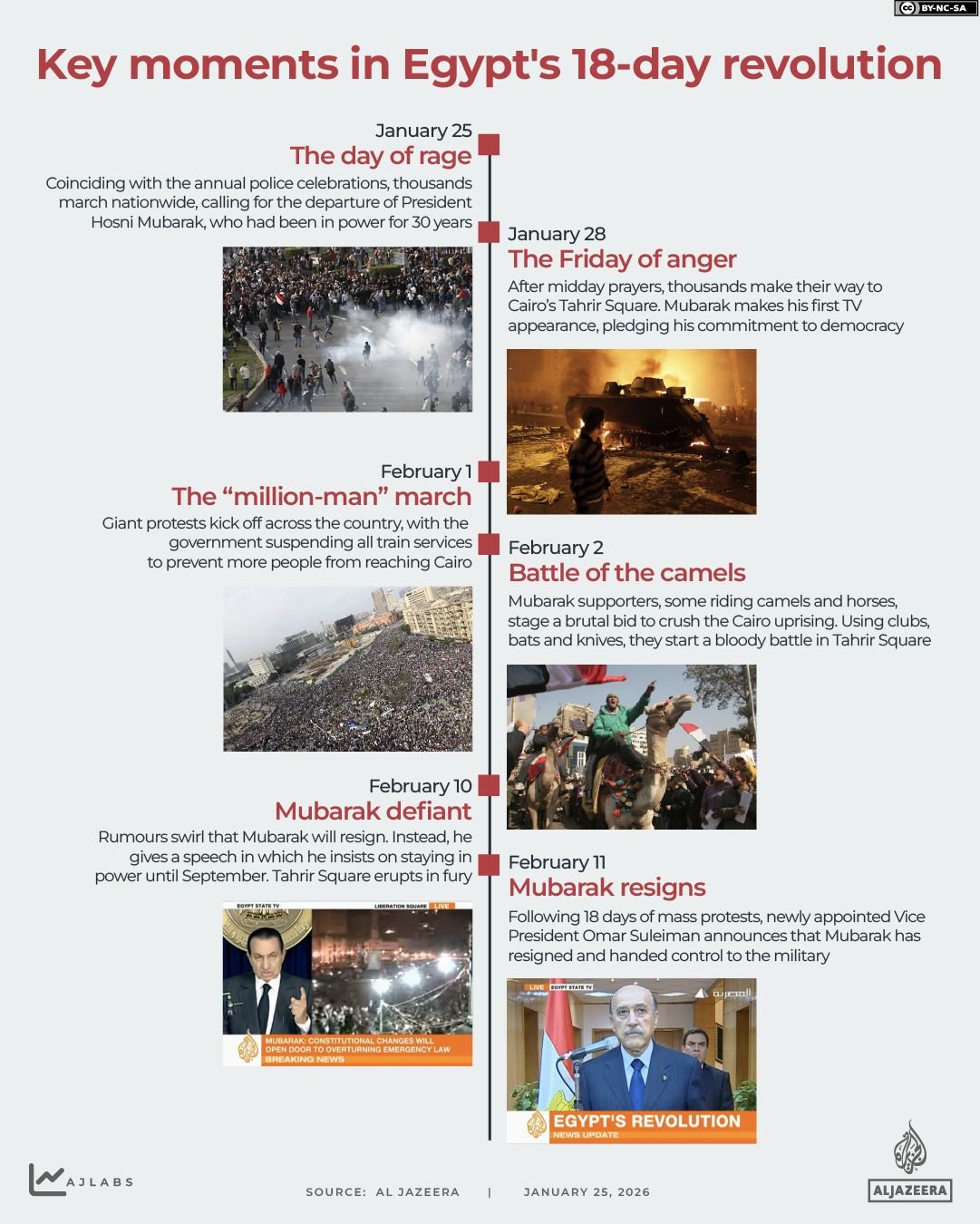
    The Egyptian revolution began with large protests on January 25 and lasted for 18 days, ending with the resignation of President Hosni Mubarak on February 11, when he handed authority to the military.

    Using their mobile phones and social media, Egyptians broadcast videos and images of their struggle for the whole world to see.

    Here are some of the main events that unfolded during those 18 days:
    INTERACTIVE - Key moments in Egypts 18 day revolution-1769322613

    • January 25 – Day of rage – Coinciding with the annual police celebration, thousands march nationwide, calling for the departure of President Hosni Mubarak, who had been in power for 30 years.
    • January 28 – Friday of anger – After midday prayers, thousands make their way to Cairo’s Tahrir Square. Mubarak makes his first TV appearance, pledging his commitment to democracy.
    • February 1 – The “million-man” march – Giant protests kick off across the country and the government suspends all train services to prevent more people from reaching Cairo.
    • February 2 – Battle of the camels – Mubarak supporters, some riding camels and horses, stage a brutal bid to crush the Cairo uprising. Using clubs, bats and knives, they start a bloody battle in Tahrir Square.
    • February 10 – Mubarak defiant – Rumours swirl that Mubarak will resign. Instead, he gives a speech in which he insists on staying in power until September. Tahrir Square erupts in fury.
    • February 11 – Mubarak resigns – Following 18 days of mass protests, newly appointed Vice President Omar Suleiman announces that Mubarak has resigned and handed control to the military.

    Youth populations in other Arab Spring countries

    Like Egypt, the four other countries which overthrew their leaders have young populations.

    In Tunisia, 2.95 million people, or 24 percent of the country’s 12.2 million population, are under the age of 15.

    In Libya, this figure is 27 percent, with two million of the country’s 7.4 million residents being under 15.

    In Syria, 29 percent of the population, or 7.2 million out of 25 million, is under the age of 15.

    Yemen has the highest percentage, with 41 percent, equating to 17 million of the country’s 40 million population being under 15.

    These population distributions are illustrated in the graphic below.
    INTERACTIVE - Arab Spring countries youth populations-1769322697

    Arab Spring Egypt Explainer Infographic Interactive Middle East News Protests
    Share. Facebook Twitter Pinterest LinkedIn Tumblr Email Telegram Copy Link
    Gulf News Week

    Related Posts

    Featured

    Saudi Arabia Warns Iran of Retaliation as Gulf War Escalates

    March 8, 2026
    Editor's Choice

    Indian investors continue to power Dubai’s property boom 

    March 8, 2026
    Editor's Choice

    Oil spike, war jitters rattle crypto markets as Bitcoin slips below $70,000

    March 8, 2026
    Iran War

    Iran Rejects US ‘Surrender’ Demand as President Apologizes for Gulf Strikes

    March 7, 2026
    Iran War

    Dubai Halts Airport Operations After Explosions as Iran War Escalates

    March 7, 2026
    Iran War

    A Kurdish Front Against Iran? Strategic Gamble Faces Resistance in Iraq

    March 7, 2026
    Add A Comment

    Comments are closed.

    Editors Picks

    Saudi Arabia Warns Iran of Retaliation as Gulf War Escalates

    March 8, 2026

    Indian investors continue to power Dubai’s property boom 

    March 8, 2026

    Oil spike, war jitters rattle crypto markets as Bitcoin slips below $70,000

    March 8, 2026

    Iran Rejects US ‘Surrender’ Demand as President Apologizes for Gulf Strikes

    March 7, 2026
    Latest Posts

    Saudi Arabia Warns Iran of Retaliation as Gulf War Escalates

    March 8, 2026

    Indian investors continue to power Dubai’s property boom 

    March 8, 2026

    Oil spike, war jitters rattle crypto markets as Bitcoin slips below $70,000

    March 8, 2026

    Subscribe to News

    Get the latest sports news from NewsSite about world, sports and politics.

    Advertisement
    Demo
    Gulf News Week

    Your source for the serious news. This demo is crafted specifically to exhibit the use of the theme as a news site. Visit our main page for more demos.

    We're social. Connect with us:

    Facebook X (Twitter) Instagram Pinterest YouTube
    Latest Posts

    Saudi Arabia Warns Iran of Retaliation as Gulf War Escalates

    March 8, 2026

    Indian investors continue to power Dubai’s property boom 

    March 8, 2026

    Oil spike, war jitters rattle crypto markets as Bitcoin slips below $70,000

    March 8, 2026

    Subscribe to Updates

    Get the latest creative news from FooBar about art, design and business.

    © 2026 Gulf News Week. Designed by HAM Digital Media.
    • Home
    • Politics
    • Economy
    • Sports

    Type above and press Enter to search. Press Esc to cancel.