
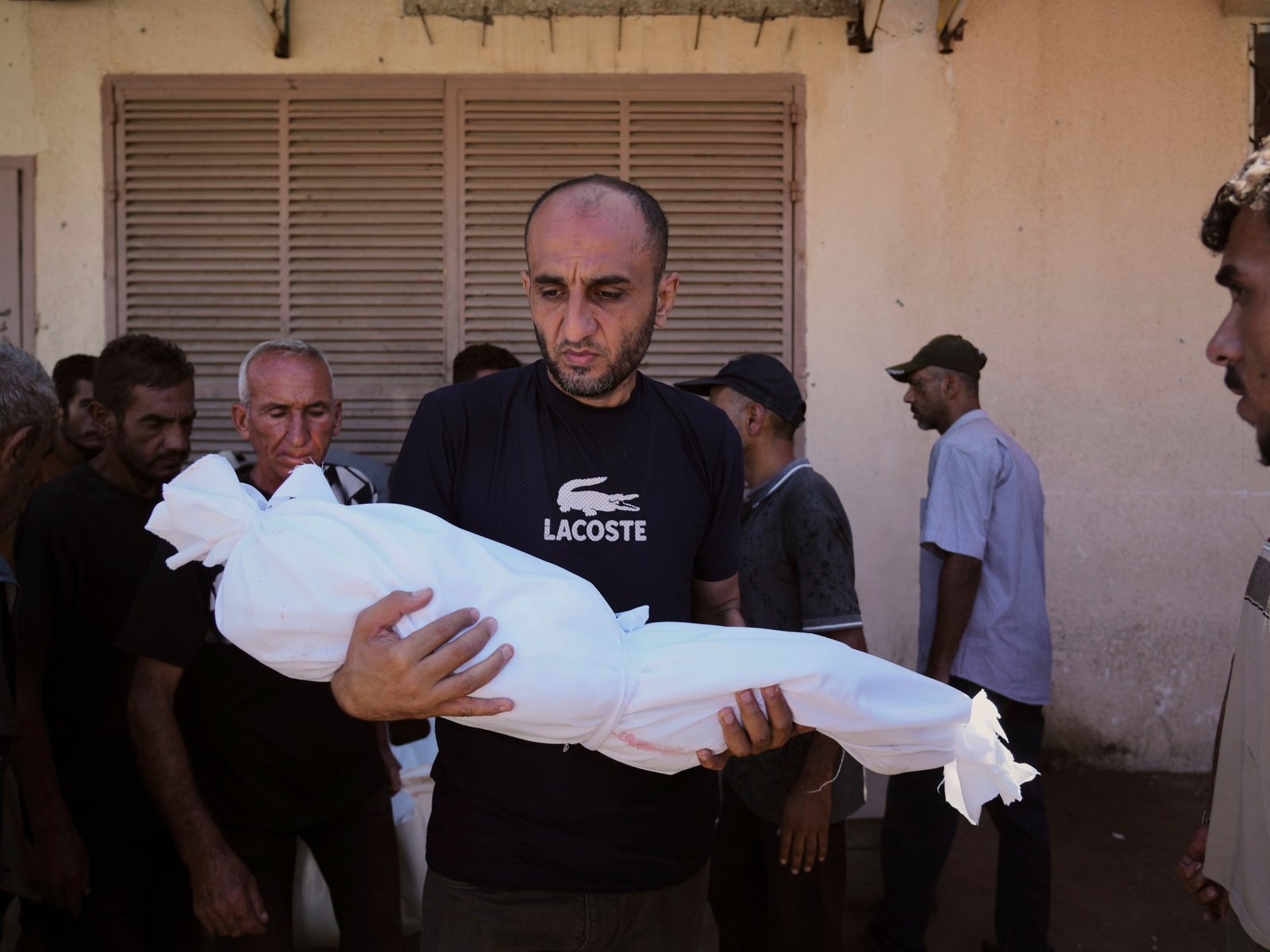
Israel has dehumanised Palestinians for decades, eventually leading to the current Gaza genocide, analysts say.
Committing a genocide – as a United Nations commission has found Israel has done in Gaza – requires one force to attempt to exterminate another people. But to commit that level of violence, it is necessary to see those being killed as not the same as you, as below human. The population needs to be dehumanised.
That’s the conclusion reached by Navi Pillay, the head of the UN commission responsible for saying that Israel is committing a genocide, joining a growing list of bodies that have come to the same conclusion.
Recommended Stories
list of 4 items
- list 1 of 4Captured state: Israel 20 years after disengaging from Gaza
- list 2 of 4Doctors can’t stop genocide. World leaders can
- list 3 of 4What the UN inquiry says about Israel’s genocide on Gaza
- list 4 of 4UN: Israel’s war on Gaza is genocide
end of list
“When I look at the facts in the Rwandan genocide, it’s very, very similar to this. You dehumanise your victims. They’re animals, and so therefore, without conscience, you can kill them,” said Pillay, a former International Criminal Court judge.
For many observers within Israel, that process of dehumanisation – where the value of Palestinian life is negligible – didn’t begin with Israel’s war on Gaza, but reaches back throughout the country’s short history and continues to inform the attitude of its public and politicians today.
Genocidal war
Israel is currently pummelling Gaza City, knowing that tens of thousands of Palestinian civilians remain there, in a region where famine has been declared. The Israeli objective appears to be to force civilians to leave so that the city – once the hub of Palestinian life in Gaza – can be destroyed, making it easier to fight Hamas, and showcasing some sort of victory to the Israeli public.
The suffering of the people of Gaza City is rarely considered in public statements from Israeli officials. Bombing them to force them to move has become normalised, and even celebrated.
Israel’s Defence Minister Israel Katz has openly bragged that “Gaza is burning” – Gaza City, the place described by the UN Children’s Fund (UNICEF) as “the last refuge for families in the northern Gaza Strip”.
However, the Israeli public’s anguish over the death toll in Gaza and its army’s actions has remained negligible. Anti-government demonstrations have focused almost exclusively on calling for a deal to secure the return of the remaining Israeli captives held in Gaza, rather than demanding a halt to the slaughter – more than 64,900 Palestinians killed – carried out in the public’s name.
A poll released in mid-August by the Israeli research group the aChord Center found that 76 percent of Jewish Israelis surveyed either fully or partially agreed with the suggestion that, among what remained of Gaza’s prewar population of 2.2 million, none were innocent.
“Genocide does not just happen,” Orly Noy, journalist and editor of the Israeli Hebrew-language magazine Local Call, told media. “A society does not just become genocidal overnight. The conditions have to be in place before that.
“It’s systematic,” she said.
A history of dehumanisation
The shock and fury with which Israel continues to view the Hamas-led attack of October 7, 2023 – in which 1,139 people were killed – is borne of the ignorance of Palestinian lives and the daily experience of living under occupation, said Yair Dvir, spokesperson for the Israeli human rights organisation B’Tselem.
The attack, he told media, seemed to many to come from “nowhere and without any apparent provocation. Israel was just attacked by these ‘demons’”.
“People knew nothing of the decades of occupation that had come before it,” he said.
In late July, B’Tselem, along with Physicians for Human Rights-Israel, concluded that Israel’s war on Gaza amounted to genocide.
In its report, B’Tselem documented Israeli violations against Palestinians from the Nakba, the 1948 ethnic cleansing of Palestine by Zionist militias, to make way for the declaration of the state of Israel to the present. Throughout, the organisation described decades of policy intended solely “to cement the supremacy of the Jewish group across the entire territory under Israeli control”.
“You can go years without even meeting a Palestinian. We have separate education systems,” Dvir continued. “We’re not taught their language, their culture or anything about their history. Most people don’t even know about the Nakba.”
“In Zionism and the education system… it’s always the ‘other’. They’re a threat,” he said.
“We even refer to them as ‘Arab Israelis’, and when they reply with: ‘No, we’re Palestinians,’ it’s as if they’ve said something shocking … It’s like they’ve just said they support Hamas. We don’t even allow their identity,” Dvir continued. “People often talk about the dehumanisation of Palestinians when they’re compared to animals, but that’s just the furthest reaches.”
Systems of dehumanisation
“It’s not just that Palestinians are the enemy; they’re viewed exclusively through a colonial gaze,” Noy said. “They’re the natives, to be regarded with contempt. They’re somehow worthless and inferior by birth.”
“This is a notion that is fundamental to Israeli society; this sense that Palestinian lives are worth less,” Noy said.
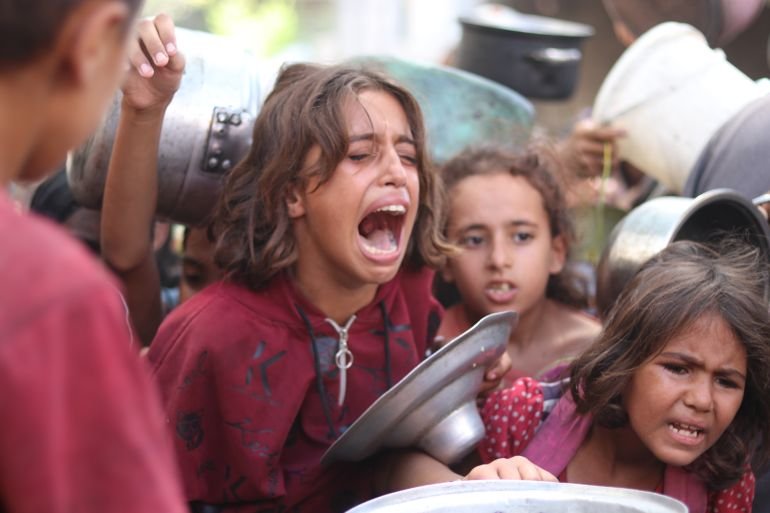
As early as 1967, Israeli officials, including David Hacohen, who was then the ambassador to Burma (Myanmar), were documented denying that Palestinians were even human. By 1985, an analysis of hundreds of Hebrew children’s books revealed dozens depicting Palestinians as “war lovers, devious monsters, bloodthirsty dogs, preying wolves, or vipers”.
Two decades later, research showed that one in 10 Israeli schoolchildren, when asked to draw Palestinians, portrayed them as animals – the same generation that now forms part of the army in Gaza.
The instinct to dehumanise Palestinians to the point where their mass killing is acceptable had always been present among Israel’s hardline religious right, Israeli analyst Nimrod Flaschenberg said from Berlin. However, it was the 2005 withdrawal of the settlements from Gaza that mobilised them to act in response to what they saw as the creeping liberalism overtaking Israeli society.
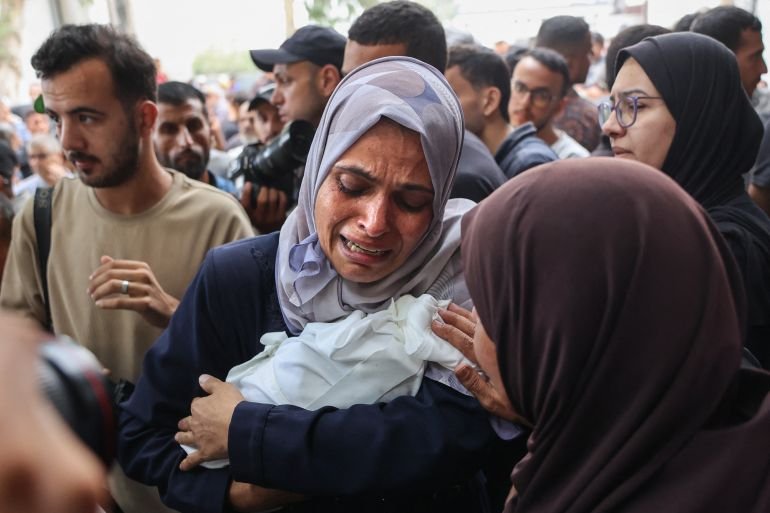
Undertaking the self-described “march through the institutions”, Flaschenberg described the deliberate campaign of settler groups and their allies on the religious right to take control of the institutions governing Israeli life, such as the country’s bureaucratic, educational, media and even military institutions, to ensure that their views became the norm.
“That belief system continues today,“ Flaschenberg said.
Attitude runs deep
“The difference between fascists, like [hard right National Security Minister Itamar] Ben-Gvir and those who imagine themselves as coming from the liberal centre, is very thin,” said Israeli sociologist Yehouda Shenhav-Shahrabani.
He went on to refer to the recent example of comments by Israel’s former head of intelligence, Aharon Haliva, a man Shenhav-Shahrabani said most Israelis would regard as a liberal, but who was nevertheless recorded saying that 50 Palestinians must be killed for every Israeli life lost on October 7, and “it does not matter now if they are children”.
“They need a Nakba every now and then, and then to feel the price,” he added.
![MAJOR-GENERAL AHARON HALIVA, CHIEF OF ISRAELI MILITARY INTELLIGENCE DURING A PANEL AT TEL AVIV UNIVERSITY'S INSTITUTE FOR NATIONAL SECURITY STUDIES (INSS) [Screen grab/Reuters]](https://gulfnewsweek.com/wp-content/uploads/2025/09/Dehumanisation-How-Israel-is-able-to-commit-its-genocide-in.png)
Israelis’ attitude towards Palestinians runs deep, Shenhav-Shahrabani said, describing a process that reached back beyond the creation of the Israeli state to early British descriptions of Palestine as a “land without a people”, casting the region’s inhabitants as some kind of shiftless mass with no traditional political centre that could be negotiated with.
That attitude towards Palestinians – as an entity disconnected from either land or home – was adopted by Israel and carries through to current discussions taking place within Israel as to how both Gaza and, ultimately, the occupied West Bank, could be ethnically cleansed.
“The notion that the Palestinian presence was temporary has always been there, it’s ‘telos’ [inevitable],” Shenhav-Shahrabani said.
“People asking why didn’t they ‘finish the job’ in [19]48 or [19]67 [in the war that led to the present-day occupation of Palestinian territory] is commonplace,” he said. “People see Palestinians being displaced as inevitable. We talk about the Nakba as an event, but it’s a process. It’s a continuous event. It’s happening now in the West Bank and in Gaza.”
