
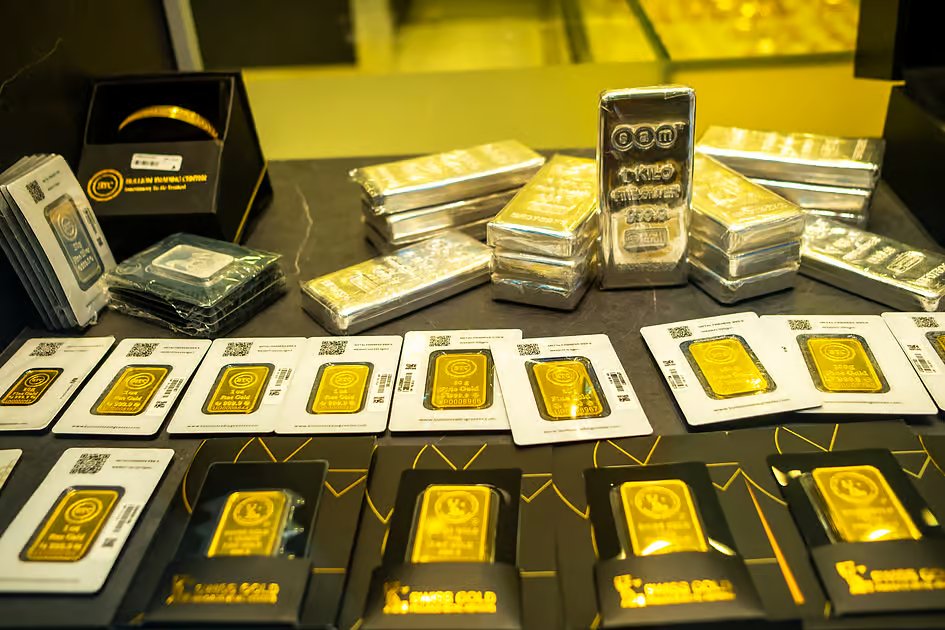
Gold is attempting to stabilise above the critical $4,000-an-ounce level after suffering one of its sharpest corrections in recent years, but analysts warn that the precious metal remains vulnerable to further volatility as investors await crucial signals from the US Federal Reserve and fresh inflation data.
After surging to a record high of $5,595 an ounce in January amid heightened Middle East tensions and safe-haven buying, spot gold has fallen nearly 25 per cent, briefly touching a six-month low this week before recovering to around $4,223 an ounce on Friday.
The sharp decline has pushed bullion into bear-market territory and wiped out much of the extraordinary gains recorded during the first quarter. Yet despite the sell-off, gold has managed to hold above the psychologically important $4,000 threshold, a level many analysts believe will determine the market’s next major move.
While gold ended the week down more than two per cent, marking its fifth consecutive weekly decline, the ability to defend the $4,000 level has encouraged some investors to cautiously return to the market.
“Gold’s ability to maintain the $4,000 level reflects the presence of strategic buyers who view any pullback as an opportunity to build new positions,” said Simon-Peter Massabni, head of Business Development at XS.com.
“I also believe that the deep correction phase is approaching its end, and that the market is now closer to building a new price base rather than entering a broader corrective downtrend.”
The recent sell-off reflects a dramatic shift in market sentiment.
The same Middle East conflict that initially fuelled gold’s record-breaking rally subsequently contributed to its correction by driving oil prices sharply higher, stoking inflation fears and strengthening expectations that US interest rates could remain elevated for longer.
Higher interest rates increase the opportunity cost of holding non-yielding assets such as gold, while a stronger dollar typically makes bullion more expensive for international buyers.
“In the very short term, the market has to digest the risk of a Fed hike and a stronger dollar,” said Aakash Doshi, head of Gold and Metals Strategy at State Street Investment Management.
The changing outlook has been painful for investors who entered the market near its highs.
According to Standard Chartered precious metals analyst Suki Cooper, at least 270 tonnes of gold held in exchange-traded funds are now in loss-making territory at prices below $4,250 an ounce, highlighting the extent of the recent correction.
Technical analysts also remain cautious.
Fawad Razaqzada, market analyst at FOREX.com, warned that gold has suffered significant chart damage after falling below its 200-day moving average, a closely watched indicator of long-term momentum.
“The technical picture has deteriorated noticeably following last week’s sell-off,” he said.
“Gold’s inability to sustain gains above the $4,500 region ultimately left the market vulnerable to a deeper correction.”
Razaqzada noted that the next major support level lies near $4,230, followed by the March lows around $4,100. A sustained break below those levels could expose the market to a test of $4,000.
However, analysts say the market’s ability to hold above that threshold suggests long-term investors are beginning to see value following the correction.
Michele Schneider, Chief Market Strategist at MarketGauge, said the recent rebound is encouraging, although she believes confirmation is still needed before declaring a durable bottom.
“If we can close up at these levels right here, that would tell me that it might be time to at least nibble,” Schneider said.
“Gold and silver need to get back above their moving averages before it’s an active buy.”
The next major catalyst is likely to come from the US Federal Reserve, which is scheduled to announce its latest monetary policy decision this week under new chairman Kevin Warsh.
Although economists do not expect an immediate rate increase, markets are increasingly pricing in the possibility of further tightening later this year as inflation remains stubbornly above target.
Analysts say Warsh’s comments during his post-meeting press conference could prove more important than the policy decision itself.
Barbara Lambrecht, commodity analyst at Commerzbank, said the new Fed chairman’s tone will be closely scrutinised for clues about future interest-rate policy.
“If Kevin Warsh were to surprise the market with hawkish remarks, the gold price would likely fall further,” she said.
“If, on the other hand, he were to dampen expectations of interest rate hikes, the gold price would likely recover slightly.”
Inflation remains the central concern for gold investors.
Markets are preparing for fresh US economic data that could reinforce expectations that the Federal Reserve will maintain a restrictive monetary stance. Elevated inflation tends to support gold as a store of value over the long term, but in the short term, it often boosts bond yields and the dollar, creating headwinds for bullion.
At the same time, geopolitical developments remain a wild card.
Recent optimism surrounding possible diplomatic progress between Washington and Tehran has reduced demand for traditional safe-haven assets. However, analysts caution that the situation remains fluid and could quickly reverse if tensions flare again.
Despite the near-term uncertainty, most analysts remain constructive on gold’s longer-term outlook.
Massabni said that central bank purchases continue to provide powerful structural support for the market as monetary authorities diversify their reserves away from the US dollar.
He also pointed to rising sovereign debt burdens, fiscal imbalances and persistent geopolitical uncertainty as factors that continue to underpin demand for gold as a strategic asset.
Those longer-term drivers help explain why many institutional investors are treating the current correction as a consolidation rather than the end of the secular bull market.
For now, however, gold remains trapped between conflicting forces. On one side are rising inflation expectations, a stronger dollar and fears of further Fed tightening. On the other hand, there are central bank buying, fiscal concerns, and lingering geopolitical risks.
The battle between those factors is likely to determine whether gold can build a durable base above $4,000 — or whether the precious metal faces another leg lower before the next phase of its long-term rally begins.
