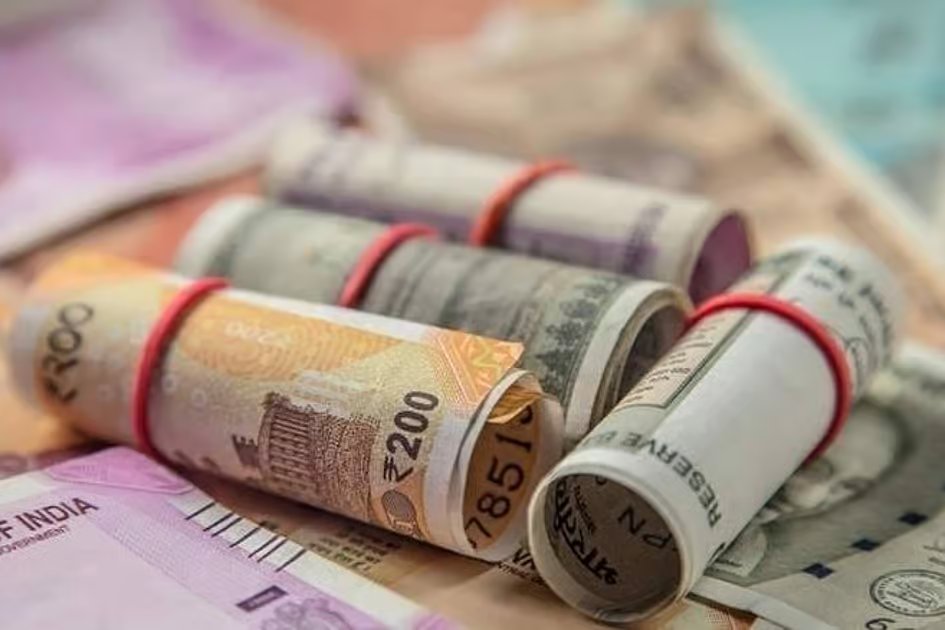
Al Ansari Exchange CEO says NRIs in the UAE taking advantage of the favourable exchange rate by transferring funds to India ahead of the Eid Al Adha holidays
The Indian rupee continued its downward trajectory on Wednesday, slipping to a new record low and is expected to remain under pressure in the near term due to high oil prices and foreign fund outflows from the country’s stock markets, analysts said.
The rupee was just shy of 97 against the US dollar, falling to 96.9 (26.38 against the UAE dirham) on Wednesday morning.
However, the rupee could find support against the US dollar and the dirham if India’s gold imports decline following an import duty hike, and if oil prices ease in the event of a potential US-Iran peace deal.
Abhishek Datta, vice-president at The Continental Group, said structurally, the rupee remains under pressure due to inflation differentials between India and the US.
“For example, if inflation in India is 5 per cent and 2 per cent in the US, the only way the rupee can stay competitive is by depreciating by around 3 per cent every year,” he said.
Vijay Valecha, chief investment officer at Century Financial, said the rupee is also facing pressure from sustained foreign portfolio investment outflows and a strong US dollar.
“This pressure intensified after the Middle Eastern conflict, as India imports about 80–85% of its crude oil, with around half of it transiting via the Strait of Hormuz. In fact, according to the Observer Research Foundation (ORF), for every $10 increase in crude oil prices, India’s current account deficit widens by 40–50 basis points. Hence, to strengthen the rupee, crude oil prices must decline, the US dollar must weaken, and foreign investment inflows must increase,” he said.
Oil prices have been trading above $100 a barrel following the outbreak of the US-Israel-Iran conflict on February 28, pushing fuel prices higher globally and putting pressure on currencies of oil-importing countries.
“As oil prices are expected to remain elevated, dollar strength is likely to continue, and other emerging markets such as South Korea and Taiwan are gaining traction, the rupee is expected to continue depreciating further,” added Vijay Valecha.
Going forward, Valecha said the rupee’s trajectory will largely be dictated by oil prices, US bond yields, foreign capital flows, and intervention by the Reserve Bank of India.
Bounce back, undervalued
The Indian rupee has been under consistent pressure in 2026, falling by around 7 per cent, mainly due to US President Donald Trump’s tariff threats and the Middle East conflict.
“The Indian rupee now appears slightly undervalued against the dollar when looking at the real effective exchange rate (REER), even though short-term market forces are still weakening it in nominal terms,” he said.
He added that the Reserve Bank of India’s 40-currency REER index, which adjusts for inflation differences, recently dropped below its usual level of 100. In March, the rupee’s 40-currency REER fell to 92.72, the lowest in over ten years.
“This shows the currency is trading well below its fair value in real terms,” he added.
This marks a sharp reversal from late-2024, when the Indian rupee appeared overvalued, with a real effective exchange rate (REER) of roughly 105.41, according to Reserve Bank of India bulletin data.
Even though valuation metrics suggest the rupee is fundamentally undervalued, Vijay Valecha added that the currency may still remain under pressure in the near term due to dollar demand driven by higher oil imports to secure supplies, as well as sizeable equity outflows amid heightened risk aversion and concerns over India’s balance of payments position.
Abhishek Datta added that if geopolitical tensions ease and oil prices decline, the rupee could stage a recovery.
“In the short term, you could see a bounce back, and it should rationalise to somewhere in the early 90s because it’s currently significantly undervalued against the basket of its trading partners. It should bounce back a little,” he said.
“As an export-oriented country, India needs to increase its exports. The only way to remain competitive in the global market is to keep the currency weak enough. If it’s too strong, exports become expensive and buyers shift to other markets where currencies are cheaper,” he added.
India imports a large amount of oil to meet its economy’s needs. Therefore, every $10 increase in oil prices adds around $9 billion to its current account deficit.
Boost for remittances
Ali Al Najjar, CEO of Al Ansari Exchange, said the rupee touching record lows has had a direct impact on remittance patterns among UAE-based Indian expatriates, with many choosing to transfer funds to India ahead of the Eid al-Adha to take advantage of favourable exchange rates.
“We have witnessed a noticeable increase in remittance activity during this period. The UAE continues to rank among the world’s most efficient remittance corridors, with transfer costs remaining well below the global average. Supported by a strong regulatory framework and seamless digital capabilities, the market allows funds to be moved quickly, securely and efficiently at the right moment,” said Al Najjar.