
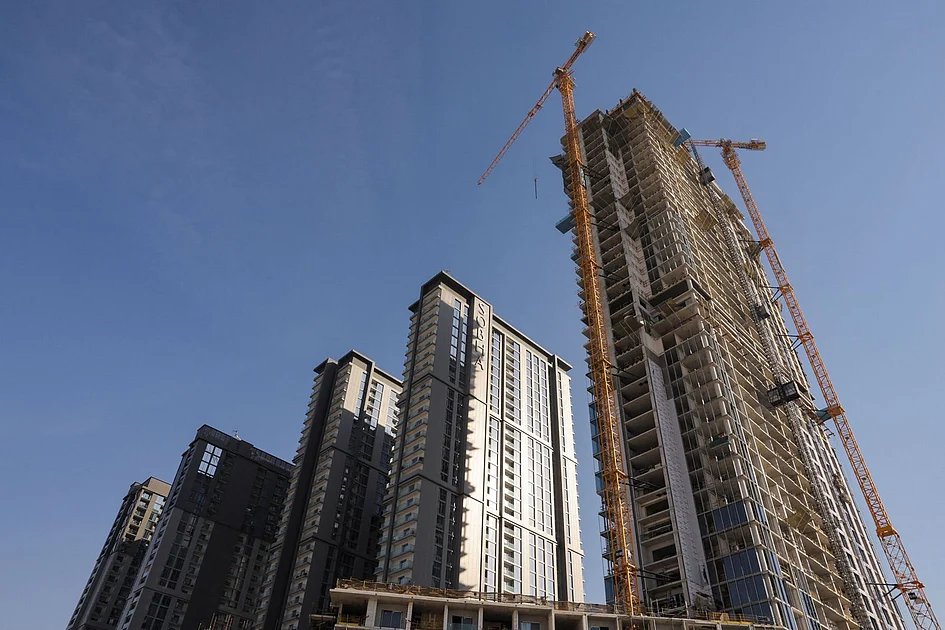
Dubai’s off-plan residential market is powering into 2026 with strong momentum, but mounting debate over speculative activity and exit risks is prompting investors and developers alike to reassess whether the current cycle can sustain its rapid gains.
Off-plan transactions continue to dominate the emirate’s housing market, accounting for roughly 70 per cent of total residential deals, driven by flexible payment plans, lower entry prices and expectations of capital appreciation.
Early 2026 figures show Dh25.98 billion in off-plan sales across 10,623 transactions, a 45 per cent year-on-year increase, underlining sustained appetite for new launches even after a multi-year price rally.
Apartments remain the engine of growth, accounting for 84 per cent of all off-plan transactions and generating Dh19.52 billion in value, according to Espace Real Estate.
Transaction volumes rose 37 per cent year-on-year as investors and end-users targeted master-planned communities offering relative affordability and long-term growth prospects.
Villa and townhouse sales, while constrained by limited supply, delivered Dh6.45 billion in combined sales, surging 124 per cent from a year earlier, reflecting persistent demand for larger homes amid structural shortages.
The market’s expansion has been fuelled by flagship projects in Dubai Creek Harbour, Palm Jebel Ali and Dubai South, alongside mid-market communities such as Jumeirah Village Circle, where entry-level units around Dh1 million continue to attract investors.
Major developers including Emaar, Damac, Nakheel, Sobha and Meraas remain dominant, with Emaar and Damac alone each generating about Dh4.2 billion in off-plan sales early in the year. Despite the buoyant activity, analysts say the market is entering a more mature phase after a sharp run-up in prices between 2022 and 2024.
Cushman & Wakefield noted that off-plan launches peaked in 2024 and moderated through 2025, with apartment launches declining 12 per cent year-on-year as developers adopted a more measured approach amid rising land costs and pricing sensitivity. Villa launches slipped only marginally, highlighting continued confidence in family-oriented communities driven by population growth and household formation.
“Launch activity is increasingly aligned with end-user demand rather than speculative supply,” the consultancy said, adding that the moderation reflects normalisation rather than a demand-led slowdown.
Off-plan transactions still account for about 72 per cent of residential deals, compared with 28 per cent for ready properties, underscoring the continued appeal of staged payment plans and lower upfront costs.
The dominance of off-plan sales has also revived concerns about flipping risk — where investors buy early and exit before completion for quick gains.
Data suggests the threat remains contained for now. Off-plan resales accounted for only 9 per cent of total off-plan transactions in 2025, indicating that most buyers are long-term investors or end-users rather than short-term speculators.
Property analysts say the market is witnessing a clear “flight to quality”, with investors gravitating toward reputable developers, prime locations and well-designed communities.
“End-user depth is now the key differentiator,” said Faisal Durrani, head of research for the Middle East at Knight Frank. “Projects backed by strong developers and located in established or strategic growth corridors continue to see robust demand, while weaker launches face pricing pressure.
”Evidence of localised softness has begun to emerge in some investor-heavy districts. Secondary off-plan transactions in certain sub-markets have taken place at or below initial launch prices, with double-digit discounts reported in areas such as Sobha Hartland, Damac Lagoons and Jumeirah Lake Towers.
Analysts say this reflects resistance to further price escalation and increasing difficulty for investors seeking quick exits rather than a broad market correction.“These are isolated pockets rather than systemic weakness,” said Cherif Sleiman, chief revenue officer at Property Finder. “Dubai’s population growth, economic expansion and continued global investor inflows are providing strong underlying demand, but buyers are becoming more selective and price-sensitive.”
Developers are also responding to shifting dynamics by pacing new launches and tailoring payment plans to sustain absorption. Rising construction and land costs are expected to result in fewer project launches in 2026, as developers prioritise project viability and protect margins.
This could help prevent oversupply and support price stability in the medium term. Dubai’s residential fundamentals remain supportive. Population growth, rising employment and sustained inflows of high-net-worth individuals continue to underpin housing demand. The emirate added tens of thousands of new residents in 2025, reinforcing demand for both mid-market apartments and family villas. Knight Frank estimates that Dubai’s population could approach 4 million within the next few years, sustaining long-term housing requirements.
However, analysts caution that the era of easy capital gains from early-stage investments may be fading.
As price growth moderates and the market matures, returns will depend increasingly on location, developer credibility and end-user demand rather than broad market momentum.
