Close Menu
    What's Hot

    Israeli settlers besieging Palestinian families in West Bank villageIsraeli security forces have reportedly withdrawn and about a dozen settlers are said to remain at the site where two families have been besieged since Sunday.2 hrs agoMiddle East

    August 12, 2026

    Radiation vest tested on NASA moonshot can cut astronauts’ exposure in solar storms, study suggests

    August 12, 2026

    Three ways to watch the solar eclipse without glassesWith some shops running out of stock, it may be too late to buy eclipse glasses – but you can still safely watch the spectacle using some household items. 1 day agoScience & Environment

    August 12, 2026
    Facebook X (Twitter) Instagram
    • Politics
    • Economy
    Facebook X (Twitter) Instagram
    Gulf News Week
    Subscribe
    Wednesday, August 12
    • Home
    • Politics
      • Europe
      • Middle East
      • Russia
      • Social
      • Ukraine Conflict
      • US Politics
      • World
    • Region
      • Middle East News
    • World
    • Economy
      • Banking
      • Business
      • Markets
    • Real Estate
    • Science & Tech
      • AI & Tech
      • Climate
      • Computing
      • Science
      • Space Science
      • Tech
    • Sports

      Dominant PSG put Liverpool on the brink with 2-0 Champions League quarter-final first-leg win

      April 9, 2026

      Dubai Basketball U-18 Elite Crowned Basket Cup Sarajevo 2026 Champions in Historic Debut

      April 6, 2026

      Saudi boxing crowns 20 champions as Kingdom’s Elite Belt concludes in Riyadh

      April 4, 2026

      “He Signed for a Real Fight”: Pacquiao Contradicts Mayweather Over Rematch Status

      April 3, 2026

      Arsenal Hold Off Chelsea Fightback to Reach Women’s Champions League Semi-Finals

      April 2, 2026
    • Health
    • Travel
    • Contact
    Gulf News Week
    Home»Featured Science & Tech»Radiation vest tested on NASA moonshot can cut astronauts’ exposure in solar storms, study suggests
    Featured Science & Tech

    Radiation vest tested on NASA moonshot can cut astronauts’ exposure in solar storms, study suggests

    Gulf News WeekBy Gulf News WeekAugust 12, 2026No Comments4 Mins Read
    Share Facebook Twitter Pinterest Copy Link LinkedIn Tumblr Email VKontakte Telegram
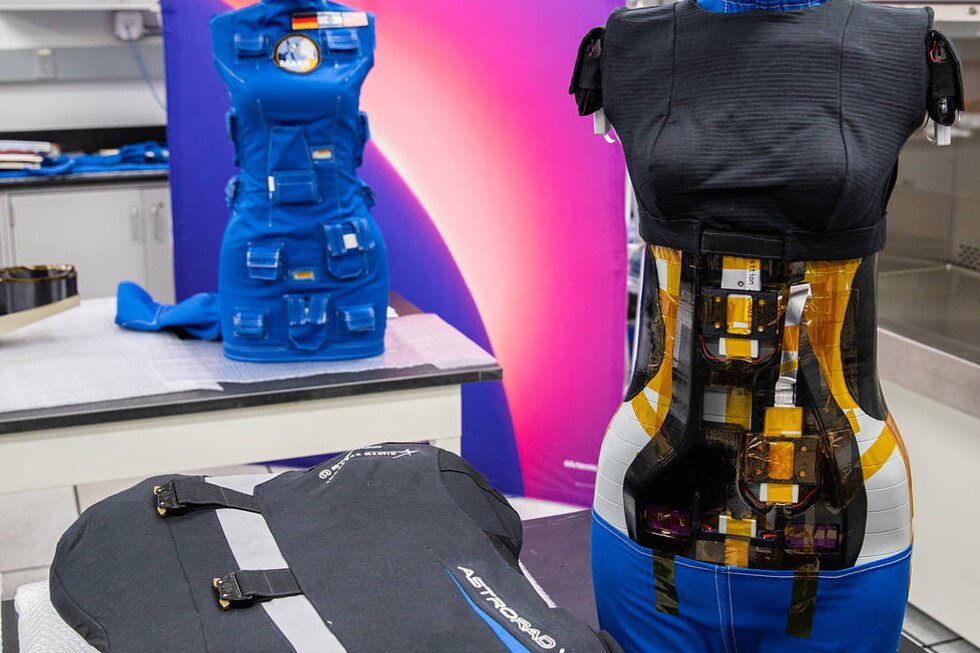
    Radiation vest tested on NASA moonshot can cut astronauts' exposure in solar storms, study suggests
    Share
    Facebook Twitter Pinterest Email Copy Link

    Cnews agenciesE CANAVERAL, Fla. (news agencies) — A new study suggests a protective vest tested on a manikin during NASA’s first Artemis moonshot could drastically cut the radiation exposure of lunar astronauts during severe solar storms.

    Scientists reported Wednesday on the radiation-shielding vest worn around the moon by a female test dummy in 2022. No one was aboard that Artemis I debut flight, which paved the way for humanity’s long-awaited return to the moon in April by a flyby crew of four.

    Radiation remains one of the biggest threats to astronauts as NASA works toward a moon base. Shielding garments could keep lunar crews safe when solar storms strike and even allow them to venture beyond their shelters if necessary, the U.S., German and Israeli team reported in the journal Science Advances.

    A version of the vest was previously tested on the International Space Station. It didn’t travel with the Artemis II astronauts since it was a short 10-day mission with limited room, but may wind up a carry-on for future moon crews.

    Meant to be worn only during high-radiation and potentially cancer-causing solar events, the vest covers the most vulnerable human organs and tissue: lungs, stomach, bone marrow, breasts and ovaries. Women are believed to be especially susceptible to radiation-induced cancer.

    Artemis I carried two female manikins that spent nearly a month flying to the moon and back. Dubbed Zohar and Helga, the manikins — each a life-size 3 feet from head to lower torso — were strapped into the passenger seats of NASA’s Orion capsule.

    Zohar wore the 57-pound (26-kilogram) AstroRad vest, developed by the U.S.-Israeli startup StemRad and Lockheed Martin. The companies had already tested a prototype on the space station for comfort and function, modeling it after gear worn by nuclear disaster teams.

    Helga flew vest-less, but like its companion contained thousands of radiation sensors.

    The study’s lead author, StemRad’s Jordan Houri, called it “the largest experiment ever conducted to determine astronaut radiation exposure beyond low-Earth orbit.” NASA, the German Aerospace Center and the Israel Space Agency provided the funding. Radiation exposure is much less for space travelers closer to home, thanks to Earth’s protective atmosphere and magnetic field.

    Artemis I encountered no major solar outbursts. But based on measurements gathered as NASA’s Orion capsule zipped through the inner Van Allen radiation belt, Houri and his team simulated how much protection the vest would provide during extreme solar particle events like those in 1972 and 1989 that detonated magnetic sea mines and collapsed a power grid.

    Lucky for NASA, the 1972 solar outburst occurred in between that year’s two moon landings, keeping the crews of Apollo 16 and 17 safe from potentially lethal radiation exposure.

    The latest findings showed the vest could reduce an astronaut’s radiation dose by about 60% in a solar storm as fierce as the one in 1972 and by nearly 40% in a calamity mirroring 1989. That’s equivalent to 193 days and 131 days, respectively, of unnecessary deep space radiation exposure, the scientists noted.

    While none of the Apollo moonshots exceeded two weeks, the moon-base stays envisioned by NASA will likely last weeks, if not months, driving up the risk of enduring a dangerous solar storm. Mars expeditions will last even longer — months, years and possibly entire lifetimes if SpaceX CEO Elon Musk achieves his goal of building a city on the red planet.

    The scientists are using their observations to trim more weight from the vest without sacrificing protection. They’re also investigating how to make radiation shielding from items already aboard a spacecraft — recycling that could save the lives of crews.

    Houri doesn’t anticipate a need for further deep-space testing anytime soon, since Zohar and Helga “provided us with an exceptionally large, high-fidelity dataset.”

    Aerospace and defense industry Astronomy Business Domestic News Elon Musk Jordan Houri National Aeronautics and Space Administration Planets Public health Science Space exploration Space Exploration Technologies Corp. Spacecraft
    Share. Facebook Twitter Pinterest LinkedIn Tumblr Email Telegram Copy Link
    Gulf News Week

    Related Posts

    Featured Science & Tech

    Looking to see the solar eclipse from North America? Here’s where and when to catch a sliver

    August 12, 2026
    Featured Health

    Trump officials propose new scrutiny of food additives and ingredients

    August 10, 2026
    Featured Science & Tech

    How to spot the Perseid meteor shower, a summer light show that promises to dazzle

    August 9, 2026
    Featured Health

    Testing is underway on vaccines to intercept brewing colon cancer before it takes root

    August 7, 2026
    Featured Health

    New kind of flu shot is on the way as the FDA approves Moderna’s mRNA-based vaccine

    August 7, 2026
    Featured Health

    Jalapeños linked to a US salmonella outbreak are tracked to a Mexican farm and a distributor

    August 7, 2026
    Add A Comment

    Comments are closed.

    Editors Picks

    Israeli settlers besieging Palestinian families in West Bank villageIsraeli security forces have reportedly withdrawn and about a dozen settlers are said to remain at the site where two families have been besieged since Sunday.2 hrs agoMiddle East

    August 12, 2026

    Radiation vest tested on NASA moonshot can cut astronauts’ exposure in solar storms, study suggests

    August 12, 2026

    Three ways to watch the solar eclipse without glassesWith some shops running out of stock, it may be too late to buy eclipse glasses – but you can still safely watch the spectacle using some household items. 1 day agoScience & Environment

    August 12, 2026

    Danube river's low water levels reveal remains of WWII soldiers and motorcycleA remarkably well-preserved motorcycle and identification tags were found alongside the bodies.5 hrs agoEurope

    August 12, 2026
    Latest Posts

    Looking to see the solar eclipse from North America? Here’s where and when to catch a sliver

    August 12, 2026

    Trump officials propose new scrutiny of food additives and ingredients

    August 10, 2026

    How to spot the Perseid meteor shower, a summer light show that promises to dazzle

    August 9, 2026

    Subscribe to News

    Get the latest sports news from NewsSite about world, sports and politics.

    Advertisement
    Demo
    Gulf News Week

    Your source for the serious news. This demo is crafted specifically to exhibit the use of the theme as a news site. Visit our main page for more demos.

    We're social. Connect with us:

    Facebook X (Twitter) Instagram Pinterest YouTube
    Latest Posts

    Israeli settlers besieging Palestinian families in West Bank villageIsraeli security forces have reportedly withdrawn and about a dozen settlers are said to remain at the site where two families have been besieged since Sunday.2 hrs agoMiddle East

    August 12, 2026

    Radiation vest tested on NASA moonshot can cut astronauts’ exposure in solar storms, study suggests

    August 12, 2026

    Three ways to watch the solar eclipse without glassesWith some shops running out of stock, it may be too late to buy eclipse glasses – but you can still safely watch the spectacle using some household items. 1 day agoScience & Environment

    August 12, 2026

    Subscribe to Updates

    Get the latest creative news from FooBar about art, design and business.

    © 2026 Gulf News Week. Designed by HAM Digital Media.
    • Home
    • Politics
    • Economy
    • Sports

    Type above and press Enter to search. Press Esc to cancel.