
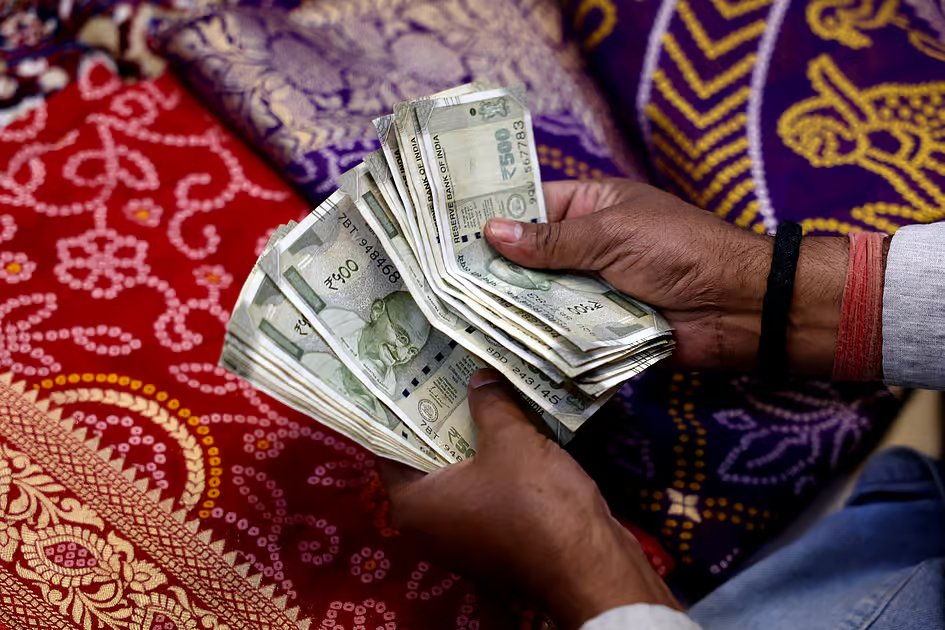
The Indian rupee came under renewed pressure on Tuesday, falling to another record low as rising oil prices, a strong US dollar, and escalating tensions around the Strait of Hormuz intensified fears of a prolonged external-sector shock for India and millions of non-resident Indians (NRIs) in the Gulf.
The rupee opened 18 paise weaker at 96.38 against the US dollar in interbank trading after closing at an all-time low of 96.20 on Monday. The sharp depreciation pushed the Indian currency close to the 26-rupee mark against the UAE dirham, significantly boosting the value of remittances for Gulf-based NRIs sending money home. The rupee has now weakened nearly 2 per cent over the last seven trading sessions despite repeated interventions by the Reserve Bank of India (RBI).
Currency analysts said the sharp depreciation reflects mounting concerns over India’s widening trade deficit, higher crude import costs and sustained foreign fund outflows amid growing geopolitical uncertainty in the Middle East.
Forex traders warned that the rupee remains especially vulnerable because India imports more than 85 per cent of its crude oil requirements, while any disruption in the Strait of Hormuz — through which nearly a fifth of global oil supply passes — could sharply raise shipping, insurance and energy costs.
“The market’s biggest challenge right now is not just direction, but confidence,” said Amit Pabari, managing director of CR Forex Advisors. “Until there is visible cooling in global tensions and stability in foreign flows, the rupee may continue trading under pressure with volatility remaining elevated.”
The decline in the Indian currency comes as Brent crude prices remain above psychologically critical levels following fears of supply disruptions in the Gulf. Higher US Treasury yields and a stronger dollar have further compounded pressure on emerging market currencies, including the rupee.
Increased remittance activity
Economists said the weakening rupee could have mixed consequences for India’s vast expatriate community in the Gulf, particularly in the UAE, home to the largest overseas Indian population.
For NRIs earning in dirhams, the falling rupee has significantly improved remittance value. A UAE resident sending Dh1,000 home now receives substantially more rupees than a few months ago, boosting household incomes and savings for families in India.
Currency exchange houses across the UAE reported increased remittance activity as many expatriates rushed to take advantage of favourable exchange rates.
However, economists cautioned that the short-term gain for NRIs may be overshadowed by broader economic pain if the currency weakness persists for long.
A weaker rupee makes imports more expensive, particularly fuel, fertilisers, electronics and edible oils, potentially fuelling inflation across India. Rising prices could eventually erode the purchasing power benefits currently enjoyed by families receiving remittances from the Gulf.
Analysts also warned that prolonged instability in the Gulf could affect employment conditions for expatriate workers if regional trade, aviation and construction sectors face disruptions linked to higher energy and logistics costs.
India’s balance of payments position is already under severe stress. Economists at HSBC have forecast a balance of payments deficit of around $65 billion for the fiscal year ending April 2027, reflecting pressure from elevated import bills and weakening capital inflows.
Foreign investors have sold more than $23 billion worth of Indian equities and bonds on a net basis since March, undermining the capital account at a time when the current account deficit is widening due to higher crude prices.
HSBC economists said the RBI is likely to continue balancing currency depreciation with the use of foreign exchange reserves to avoid disorderly market movements.
“The continued distribution of exchange market pressure between currency weakness and the use of FX reserves should likely continue,” HSBC said in a research note.
The report added that a weaker rupee could eventually help narrow the trade deficit by making Indian exports more competitive while discouraging expensive imports.
Yet economists believe the near-term outlook remains challenging as geopolitical tensions continue to unsettle global markets.
For millions of Gulf-based NRIs, the rupee’s decline presents both an opportunity and a warning — higher remittance returns today, but potentially deeper economic uncertainty for India if oil prices remain elevated and regional instability persists.
- India
