
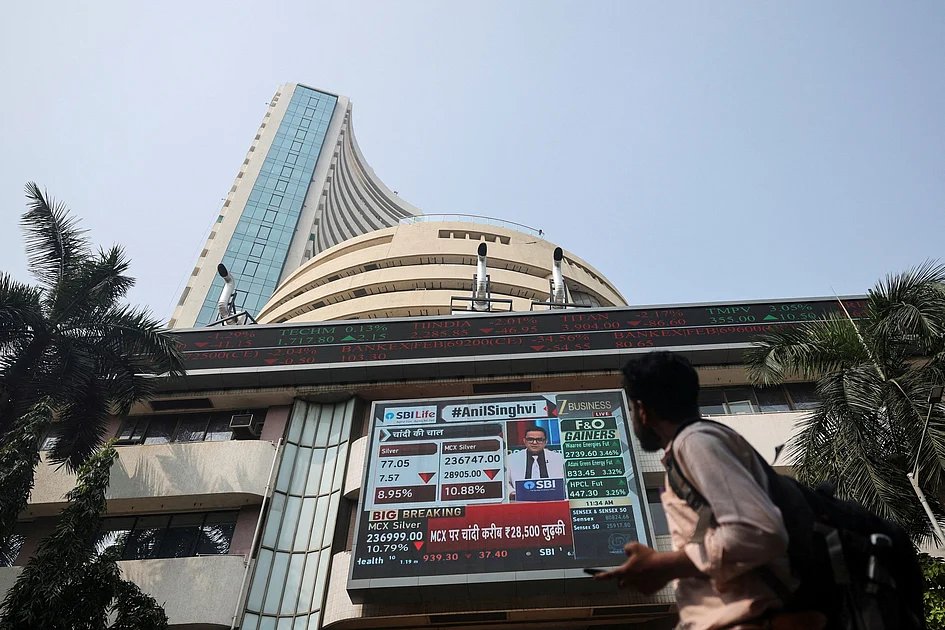
India’s equity markets have suffered a sharp setback amid escalating geopolitical tensions in the Middle East, wiping out nearly $240 billion in investor wealth in a single week and prompting the country’s market regulator to urge investors to remain cautious as volatility grips global financial systems.
Benchmark indices extended their losing streak for a third consecutive week as global investors pulled money from risk assets following the outbreak of the US-Iran conflict and fears of wider disruption to energy supplies.
The BSE Sensex dropped 1,471 points, or 1.93 per cent, on Friday to close at 74,563.92, while the Nifty 50 fell 488 points, or 2.06 per cent, ending the session at 23,151.10.
The sell-off was even sharper in the broader market. The BSE Midcap index plunged 2.61 per cent and the Small-cap index dropped 2.67 per cent, reflecting widespread risk aversion among investors.
Over the week, the Sensex lost 4,355 points, or 5.5 per cent, while the Nifty declined 5.3 per cent. The market capitalisation of companies listed on the Bombay Stock Exchange shrank to about ₹430 trillion ($5.2 trillion) from roughly ₹450 trillion ($5.4 trillion) a week earlier, translating into an erosion of about ₹20 trillion — or nearly $240 billion — in investor wealth.
Securities and Exchange Board of India (SEBI) Chairman Tuhin Kanta Pandey said the country’s capital markets have been “severely impacted” by the ongoing geopolitical crisis but emphasised that episodes of extreme volatility are typically short-lived.
“The real test for the market is whether the system continues to function smoothly and efficiently when volatility comes,” Pandey said, noting that regulators and policymakers across the world are closely monitoring developments to maintain financial stability.
Pandey highlighted that India’s financial markets have expanded dramatically over the past decade and are now far more integrated with global capital flows than before, making them increasingly sensitive to international shocks.
“As markets grow, they become more connected to global developments,” he said. “News and opinions travel very fast and markets react instantly.”
He urged investors — particularly retail participants — to remain patient during the current phase of uncertainty and avoid making impulsive decisions driven by short-term market movements.
The recent market correction comes after an unusually long period of muted returns in Indian equities. Benchmark indices have largely moved sideways for nearly 18 months, leaving many retail investors with flat portfolios despite strong economic growth.
Market participants say the latest sell-off reflects a combination of geopolitical fears, concerns over rising oil prices and global capital flight from emerging markets.
According to a recent outlook report by BMI, geopolitical tensions arising from the Middle East conflict could dampen investor sentiment and slow capital inflows into India, potentially offsetting some of the gains expected from upcoming trade agreements with the United States and the European Union.
India remains one of the world’s fastest-growing major economies, with BMI maintaining its forecast of around 7 per cent GDP growth for fiscal 2026-27. However, the research firm warned that risks to this outlook are rising, particularly if the conflict disrupts global energy supply routes.
One of the biggest vulnerabilities for India is its heavy dependence on imported crude oil. The country imports nearly 88 per cent of its crude oil needs, making it highly exposed to fluctuations in global energy prices.
A major concern for policymakers is the potential disruption of shipping through the Strait of Hormuz, one of the world’s most important oil transit routes. Iran has issued warnings to vessels passing through the corridor, raising fears that any prolonged disruption could trigger a surge in crude prices.
BMI estimates that a 10 per cent increase in oil prices could reduce India’s economic growth by 0.3 to 0.6 percentage points, while also widening the country’s trade deficit, pushing up inflation and dampening consumer spending.
Despite the near-term volatility, India continues to pursue structural reforms aimed at strengthening capital markets and attracting foreign investment.
Pandey pointed to recent changes in listing rules under the Securities Contracts (Regulation) framework, which introduce a graded approach to minimum public shareholding for large companies planning to go public.
The reforms are designed to make access to capital markets more efficient and broaden investment opportunities for both domestic and international investors.
At the same time, the Indian government has approved amendments to its foreign direct investment policy to ease funding flows into startups and deep-technology companies.
Under the revised framework, investments of up to 10 per cent non-controlling stake from investors based in countries sharing land borders with India will be permitted through the automatic route, subject to regulatory disclosures.
The move is expected to revive funding activity for Indian startups, many of which faced delays after restrictions were introduced in 2020 requiring government approval for such investments.
Analysts say the policy shift reflects a broader effort to balance national security concerns with the need to sustain capital inflows into India’s rapidly expanding technology ecosystem.
For investors navigating turbulent markets, regulators and fund managers alike are delivering a consistent message: volatility is inevitable, but India’s long-term economic fundamentals remain intact.
As Pandey put it, efficient markets cannot be built on regulation alone. “Efficient markets are a shared responsibility,” he said, underscoring the role of investors, institutions and policymakers in sustaining confidence in the financial system.
