
Global oil markets are bracing for renewed volatility as escalating military tensions in the Gulf push crude prices toward the $100-a-barrel mark and raise fears of the largest supply disruption in modern energy history.
Benchmark crude prices have surged in recent days amid mounting concerns that the conflict between the United States and Iran could severely disrupt oil flows through the Gulf — the world’s most critical energy artery. West Texas Intermediate (WTI) is trading close to $99 per barrel, while Brent crude is hovering near similar levels after briefly spiking above $100 earlier this week as traders priced in intensifying geopolitical risks.
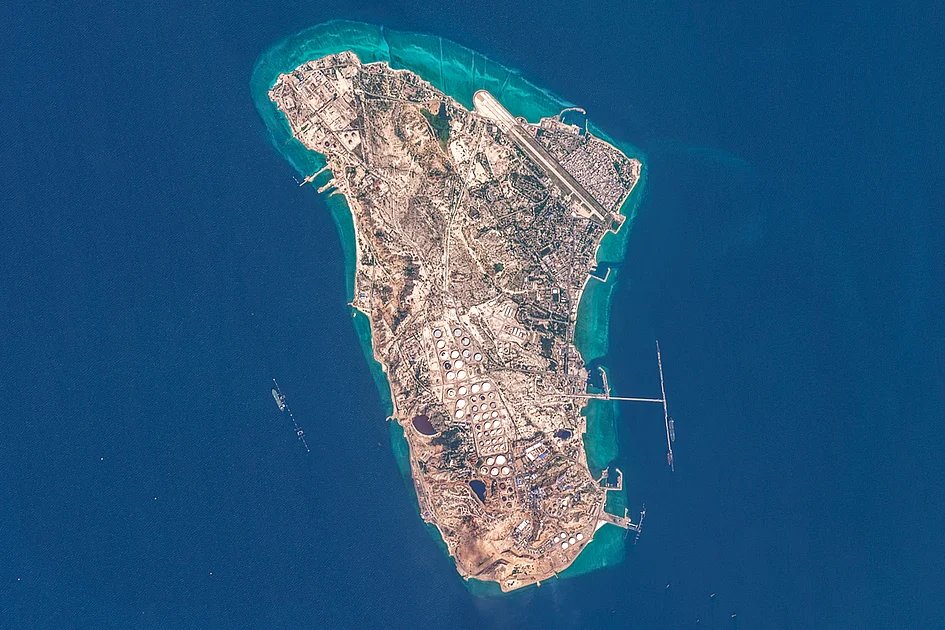
The rally in oil prices follows confirmation by US President Donald Trump that American forces had carried out a major bombing raid on Iran’s strategic Kharg Island, targeting military installations on the key Gulf outpost while warning Tehran that its vital oil infrastructure could be destroyed if shipping through the Strait of Hormuz is disrupted.
The strike marks a significant escalation in the conflict. Kharg Island, located about 25km off Iran’s southwestern coast, is the backbone of Iran’s oil export system, handling roughly 90 per cent of the country’s crude shipments and hosting extensive storage and loading facilities.
While US officials said the operation targeted military facilities and avoided the island’s oil infrastructure, the attack has dramatically heightened fears that the conflict could spread to energy installations across the Gulf.
Energy analysts warn that any serious damage to Kharg Island’s oil infrastructure could instantly remove most of Iran’s export capacity from global markets and trigger a sharp spike in crude prices. In a worst-case scenario, Brent crude could surge well above $120 per barrel, reviving fears of a global energy shock reminiscent of earlier oil crises.
The immediate concern for markets, however, remains the growing disruption to shipping through the Strait of Hormuz, the narrow maritime corridor between Iran and Oman that carries around 20 million barrels of crude oil and petroleum products per day — roughly one-fifth of global supply.
Since the outbreak of the conflict, tanker traffic through the strait has collapsed, forcing several Gulf producers to curtail production as export routes become increasingly unsafe.
The International Energy Agency (IEA) says the crisis has already triggered the largest disruption in the history of global oil markets, with Middle Eastern producers cutting output by at least 10 million barrels per day as storage facilities fill up and shipments grind to a halt.
The agency estimates that global supply could decline by around 8 million barrels per day in March, equivalent to nearly 8 per cent of world demand, if tanker traffic through the Strait of Hormuz does not resume quickly.
The collapse in oil shipments has forced producers including Saudi Arabia, Iraq, Kuwait and the UAE to reduce output because crude that cannot be exported must be stored domestically.
To stabilise markets, more than 30 industrialised nations have agreed to release around 400 million barrels of crude from strategic reserves, the largest coordinated stockpile release ever undertaken.
The United States is contributing the largest share of the emergency release, pledging 172 million barrels from its Strategic Petroleum Reserve in an effort to ease supply pressures and prevent oil prices from spiralling further.
However, analysts say the stockpile release can offer only temporary relief.
Strategic reserves are designed to cushion short-term disruptions rather than replace sustained production losses. If tanker traffic through the Strait of Hormuz remains severely restricted, the global oil market could tighten rapidly despite the emergency supply injections.
Some additional output has emerged from countries such as Russia and Kazakhstan, helping partially offset the supply shock. Yet energy experts warn that these increases are unlikely to fully compensate for the massive loss of Middle Eastern exports if the conflict intensifies.
Alternative export routes are also limited. Only Saudi Arabia and the UAE currently have pipelines capable of bypassing the Strait of Hormuz, and their combined spare capacity can redirect only a portion of the oil that normally passes through the chokepoint.
Analysts argue that the implications of a prolonged disruption extend far beyond the energy sector. Higher oil prices could fuel inflation, strain government budgets and slow global economic growth — particularly in large energy-importing economies such as India, Japan, South Korea and China.
Financial markets have already begun reacting to the turmoil, with rising energy costs contributing to volatility in equities, currencies and bond markets worldwide.
For now, oil traders are closely watching developments around Kharg Island and the security of tanker routes through the Strait of Hormuz.
Until shipping flows are restored and geopolitical tensions ease, analysts say oil markets are likely to remain highly volatile — with crude prices increasingly driven not by traditional supply-and-demand fundamentals but by the shifting dynamics of war in one of the world’s most critical energy regions.
