
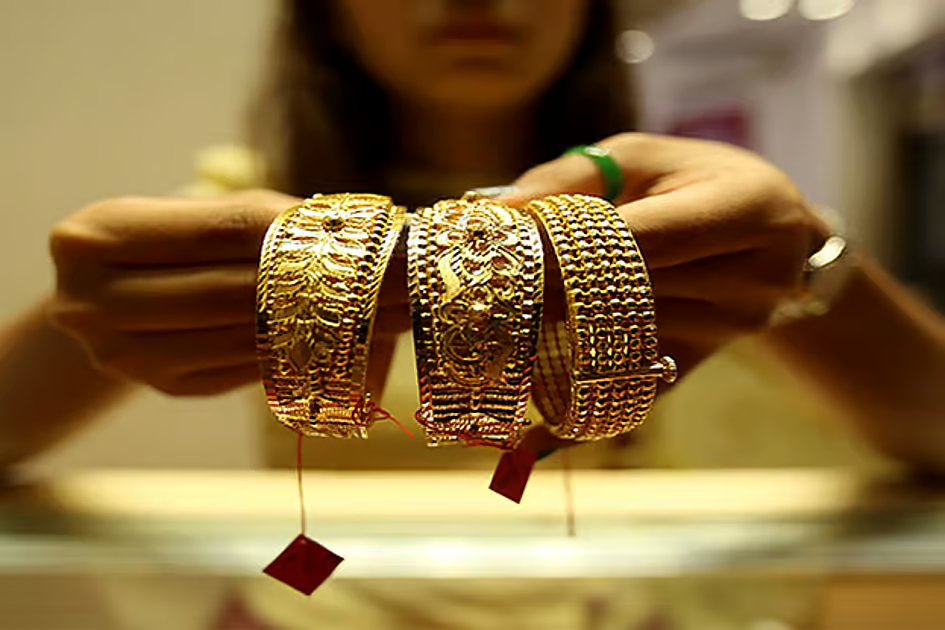
Gold may have retreated from its recent record highs following the breakthrough US-Iran peace agreement, but analysts say the precious metal’s long-term rally remains firmly intact as central banks accelerate purchases and investors continue to seek protection against an increasingly uncertain economic and geopolitical landscape.
The easing of tensions between Washington and Tehran has removed one of the most immediate triggers for safe-haven buying, prompting a pullback in gold prices after months of conflict-driven gains.
Spot gold, which surged above $4,700 an ounce during the height of the Middle East crisis, has eased back towards the $4,300-$4,500 range as fears of a prolonged disruption to oil supplies and global trade routes recede.
However, beneath the short-term volatility, the structural forces that have propelled gold to successive record highs over the past three years remain largely unchanged.
Gold as core reserve asset
A powerful signal came this week from the World Gold Council’s 2026 Central Bank Gold Reserves Survey, which showed that central banks remain overwhelmingly bullish on the metal despite its extraordinary price performance. A record 45 per cent of respondents said they intend to increase gold holdings over the next 12 months, the highest level since the survey began.
The finding underscores a remarkable trend. Central banks have been net buyers of gold for 16 consecutive years and have collectively added more than 1,000 tonnes annually for three straight years, reflecting a strategic shift in reserve management amid growing geopolitical fragmentation and concerns over excessive dependence on the US dollar.
The survey suggests that gold is increasingly being viewed not merely as a crisis hedge but as a core reserve asset in a changing global monetary order.
Gold’s ability to preserve value during periods of market stress, diversify reserve portfolios and act as a hedge against currency risks continues to rank among the leading reasons central banks are accumulating the metal. This trend has been particularly evident among emerging-market economies, where policymakers are seeking greater resilience against sanctions risks, financial market volatility and potential disruptions to the global payments system.
Technical correction
According to Carsten Menke, head of Next Generation Research at Julius Baer, the recent decline in gold prices should be viewed largely as a technical correction rather than a reversal of the broader bull market.
“Not much has changed in the medium- to longer-term backdrop,” Menke said following the finalisation of the US-Iran agreement.
He argued that much of the recent price movement reflected position squaring by short-term traders who had accumulated large speculative positions during the conflict. As tensions eased, many rushed to unwind those bets, amplifying short-term volatility.
For long-term investors, however, the bigger picture remains favourable.
“We expect investment demand to pick up again, even though it may not be as strong as prior to the start of the war,” Menke said.
More importantly, Julius Baer continues to view central-bank buying as the single strongest structural force supporting gold prices.
“We still see it as the strongest structural force in the gold market, reflecting the emerging markets’ desire to be less dependent on the US dollar as a reserve currency,” he said.
That view is increasingly shared by major global investment banks, many of which continue to forecast higher gold prices despite the recent correction.
Goldman Sachs has maintained one of the most bullish outlooks on the precious metal, forecasting gold could reach $5,400 an ounce by the end of 2026. The bank believes sustained central-bank purchases, reserve diversification away from the dollar, and lingering geopolitical uncertainty will continue to underpin prices. Goldman recently raised its estimate of official-sector gold buying and said demand from emerging-market central banks remains significantly stronger than previously anticipated.
Morgan Stanley, while adopting a more cautious tone after gold’s spectacular rally, still expects prices to remain at historically elevated levels. The bank recently revised its second-half 2026 target to around $5,200 an ounce, arguing that structural demand remains intact even as short-term momentum moderates.
JPMorgan also remains constructive on the metal, projecting gold to average about $5,055 an ounce in the fourth quarter of 2026 and potentially rise towards $5,400-$6,300 by late 2027. The bank cites continued reserve diversification, strong central-bank demand and growing concerns over sovereign debt sustainability as key drivers. Citi, meanwhile, has maintained a six-to-12-month target of around $5,000 an ounce despite recent market volatility.
Taken together, these forecasts suggest that the recent retreat is being viewed by institutional investors as a consolidation phase rather than the end of the gold bull market.
The broader macroeconomic backdrop also remains supportive.
Although the US-Iran agreement has reduced geopolitical risk premiums, it has not eliminated concerns about inflation, government debt levels, fiscal sustainability and monetary policy uncertainty. The US economy continues to grapple with a complex mix of stronger growth, elevated inflation and persistent fiscal deficits, complicating the Federal Reserve’s policy outlook.
Markets remain divided over the timing and magnitude of future US interest-rate cuts. Historically, periods of uncertainty surrounding monetary policy have tended to benefit gold because the metal performs well when investors seek alternatives to interest-bearing assets or question the long-term purchasing power of fiat currencies.
The outlook for investment demand may also improve as exchange-traded funds rebuild positions after months of profit-taking. ETF inflows were a major contributor to gold’s rally before the outbreak of the US-Iran conflict and could re-emerge as an important source of support if expectations for lower interest rates return.
At the same time, geopolitical risks remain far from resolved. While the US-Iran deal has lowered immediate tensions in the Middle East, investors continue to monitor flashpoints involving China and Taiwan, Russia and Ukraine, as well as broader concerns over trade fragmentation and strategic competition among major powers.
Such risks reinforce gold’s role as a portfolio hedge during periods of uncertainty.
The contrast with silver is becoming increasingly pronounced. While gold continues to benefit from official-sector demand and safe-haven flows, silver faces headwinds from slowing industrial consumption, particularly in China. Analysts note that substitution by cheaper materials in solar-panel manufacturing and moderating production growth are likely to weigh on silver demand in coming years.
For gold, however, the story remains fundamentally different.
The combination of sustained central-bank buying, a likely recovery in investment demand, persistent geopolitical uncertainty and ongoing efforts by many countries to diversify away from dollar-denominated reserves suggests that the yellow metal’s strategic appeal remains stronger than ever.
The recent pullback may have cooled speculative enthusiasm, but it has done little to alter the long-term narrative. If anything, central banks’ continued appetite for gold indicates that the world’s largest reserve managers remain convinced that the metal will play an even bigger role in the global financial system in the years ahead. For investors, that may be the strongest signal yet that gold’s bull market still has room to run.
