
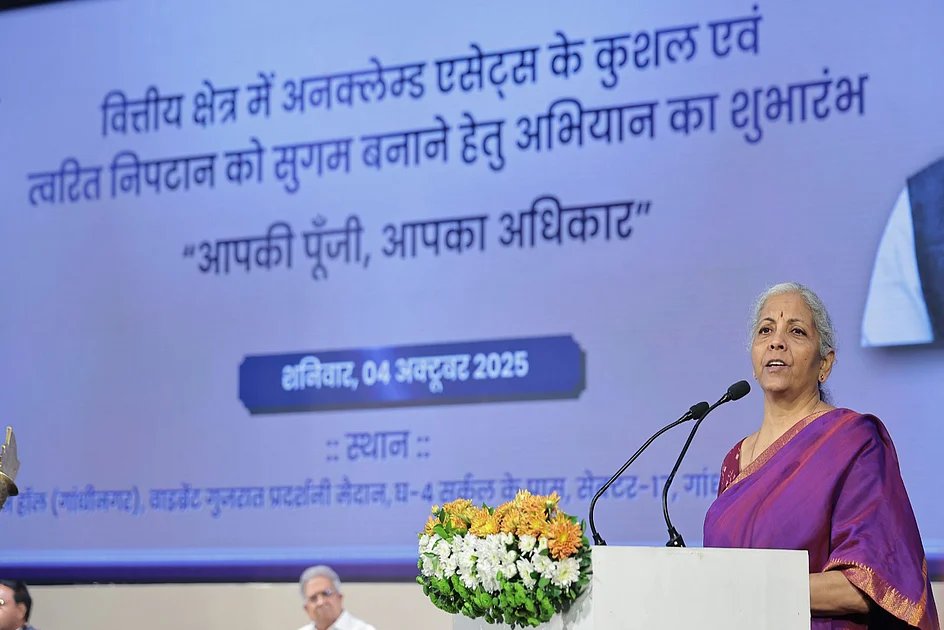
Indian Finance Minister Nirmala Sitharaman has reaffirmed India’s economic resilience and growth ambition, declaring that the country remains firmly on track to achieve 8 per cent GDP growth despite global turbulence, trade wars, and Washington’s latest tariff move targeting Indian exports.
Speaking recently at the inauguration of the fourth Kautilya Economic Conclave in New Delhi, themed “Seeking Prosperity in Turbulent Times,” the minister said India’s strong domestic fundamentals, policy discipline, and structural reforms have equipped the economy to withstand and adapt to shifting global dynamics marked by sanctions, tariffs, and decoupling strategies.
The minister’s upbeat growth projections align with the broad views held by economists that the fourth largest global economy is on course to achieve its goal of becoming a $32 trillion economic powerhouse by 1947, the centenary year of Indian independence.
“Our capacity to absorb shocks is strong, while our economic leverage is evolving,” Sitharaman said. “Our choices will determine whether resilience becomes a foundation for leadership or merely a buffer against uncertainty. History teaches us that crises often precede renewal.”
Her remarks came amid rising global concern over protectionist measures after the US imposed an additional 25 per cent tariff on Indian imports, effectively doubling existing duties. The move, which has affected sectors from steel and engineering goods to textiles, has fuelled fears of a new trade standoff between the two countries. But Sitharaman projected calm and confidence, saying India’s diversified economic base and rising domestic consumption would cushion any potential fallout.
“Geopolitical conflicts are intensifying. Sanctions, tariffs, and decoupling strategies are reshaping global supply chains,” she said. “These dynamics highlight both our vulnerability and our resilience. The Indian economy remains resilient and continues to grow sustainably.”
The finance minister noted that India’s pursuit of Viksit Bharat — becoming a developed nation by 2047 — does not mean turning inward. “Becoming a developed nation does not imply that India wants to be a closed economy,” she said. “To reach that goal, we must sustain 8 per cent GDP growth.”
In her wide-ranging address, Sitharaman painted a candid picture of a global order in flux. “Trade flows are being reshaped, alliances are being tested, investments are being rerouted along geopolitical lines, and shared commitments are being re-examined,” she said. “The present is turbulent — and to call it merely that would be an understatement.”
The minister described the current phase as one of structural transformation, not a temporary disruption, as the world shifts toward a new equilibrium shaped by competing powers and evolving economic models. “The question is: What lies on the other side of this transformation? What will the new equilibrium look like? Who will shape it, and on what terms?” she asked.
She emphasised that India’s macroeconomic stability — anchored in fiscal prudence, inflation control, and strategic reforms — stands out globally as a source of balance and confidence. “Our growth is firmly anchored in domestic factors, which minimises the impact of external shocks,” Sitharaman said. “But we must guard against complacency.”
Sitharaman acknowledged that developing nations face difficult trade-offs in today’s fractured global order — between growth and sustainability, energy transition and energy security, innovation and labour markets, and high borrowing costs and investment needs. “These trade-offs are not easily resolved, yet they cannot be ignored,” she noted.
The minister also warned that derisking and decoupling trends are reshaping globalisation and could exacerbate inequality and fragmentation. “We must confront imbalances, not just manage uncertainty,” she said. “The task is to build a global order where trade is fair, finance serves productive ends, energy is both affordable and sustainable, and climate action aligns with development imperatives.”
Addressing technological disruption, Sitharaman cited the rapid rise of stablecoins, digital currencies, and new financial architectures as forces compelling nations to adapt quickly to avoid being left behind. “The growing intersection between geopolitics and technology is redrawing the map of global influence,” she said.
While calling for inclusivity and cooperation, she also urged developing economies to assert greater agency in global decision-making. “We cannot afford to be passive spectators in a world where decisions elsewhere determine our destinies. We must be active participants, shaping outcomes where possible and preserving autonomy where necessary.”
Sitharaman ended on a note of optimism, urging nations to view the current crisis as an inflection point rather than a setback. “Let us treat this moment not only as a crisis but as an opportunity to lay out the contours of the future we wish to create,” she said.
With India’s economy projected by the IMF to grow by 6.8 per cent in 2025 and private investment, infrastructure spending, and digital transformation accelerating, analysts agree that India is better positioned than most emerging economies to weather the tariff storm. Sitharaman’s message was clear: far from being a victim of global trade realignment, India is poised to emerge as one of its key architects.
