
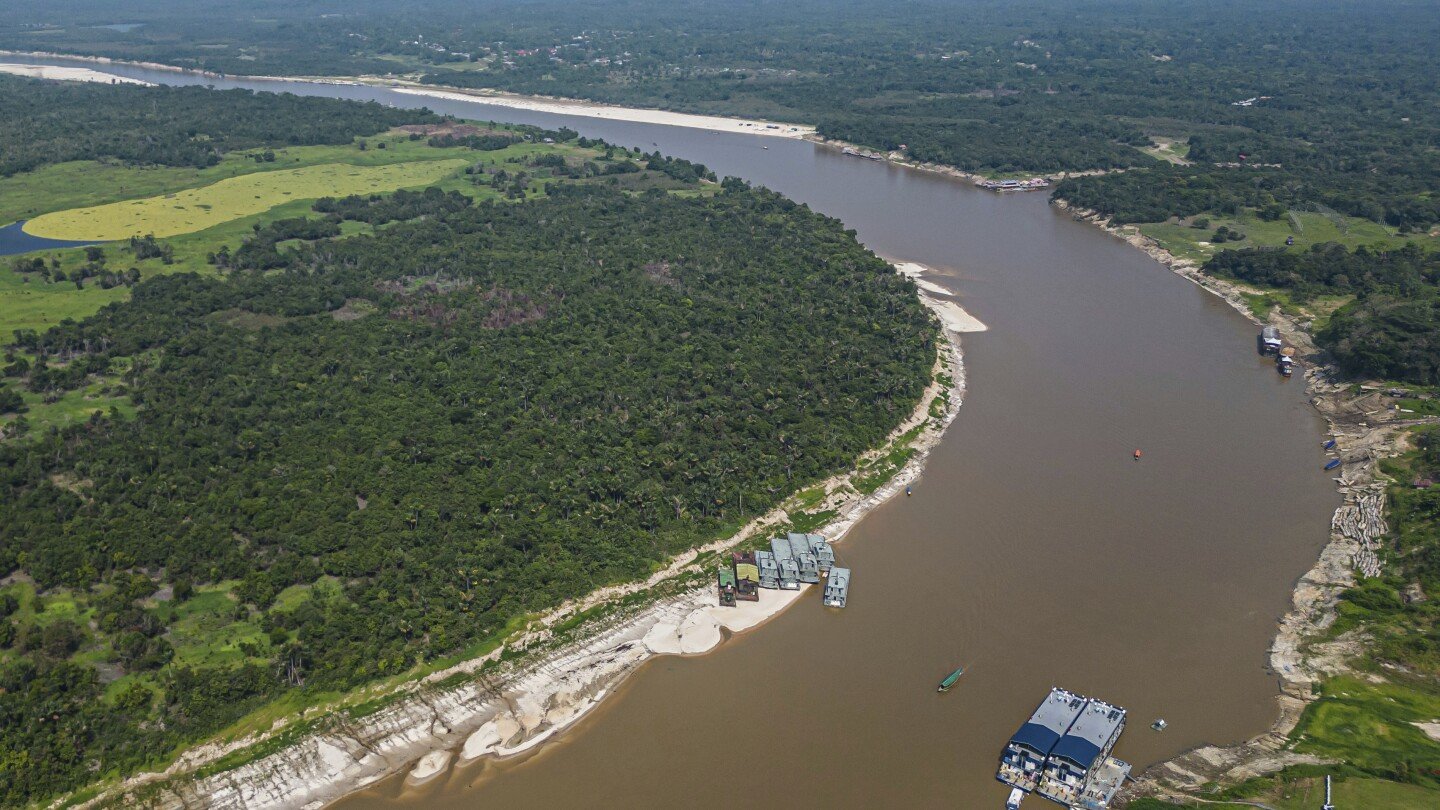
BOGOTA, Colombia (news agencies) — Indigenous and rural communities along the Nanay River in Peru’s northern Amazon filed a complaint on Friday accusing the government of failing to stop illegal gold mining that is contaminating their water and food with toxic mercury.
The complaint was submitted in the country’s capital, Lima, to the Secretariat General of the Andean Community, a regional trade bloc that includes Peru, Ecuador, Colombia and Bolivia. The communities argue that Peru has violated a binding regional policy adopted in 2012 to combat illegal mining.
A delegation of 10 leaders and residents from the Peruvian Amazon traveled to Lima for the complaint.
“Peru is not fulfilling its obligations, and that has allowed illegal mining to expand, threatening the lives and rights of Amazonian communities,” said César Ipenza, an environmental lawyer who brought the case forward on behalf of the communities.
The Peruvian government did not immediately reply to a request for comment.
Mercury, widely used in gold extraction, is polluting fish — a dietary staple — and entering the food chain in areas surrounding the Nanay and Pintuyacu rivers.
“More than 80% of our population is contaminated with mercury in the blood,” said Jhonny Huaymacari Yuyarima, who represents the Ikito Indigenous people and heads a local alliance of 33 communities in the Nanay basin. “The fish in our rivers and lakes are also poisoned.”
Huaymacari described seeing children with developmental delays, residents with chronic joint pain, skin conditions and intense headaches — symptoms many now associate with prolonged mercury exposure.
A recent study by the Center for Amazonian Scientific Innovation, or CINCIA, and the Frankfurt Zoological Society found dangerously high levels of mercury in hair samples taken from 273 residents across six river communities in the region.
About 79% of participants had mercury levels above the World Health Organization safety limit of 2.2 milligrams per kilogram.
Children up to age 4 had the highest average levels — nearly six times the recommended limit. Fish from the same area had elevated mercury concentrations, particularly in carnivorous species that are commonly eaten.
“These are not isolated cases. This is widespread exposure,” Ipenza said. “And we’re talking about people who depend on fish as their primary protein source, and on the Nanay River for drinking water — including the city of Iquitos.”
Huaymacari says it hurts to think that after more than 20 years of fighting illegal mining, “the state still doesn’t listen to us.”
“The mercury is in our bodies now. We’ll have to live with this if the Peruvian state does nothing,” he told media, citing the example of Peru’s southern region of Madre de Dios, long plagued by illegal mining.
Researchers and environmental groups now warn that the sprawling expanse of Loreto — where Iquitos is the regional capital and the home of the Nanay — is becoming the new frontier.
